Menswear / Formal Trousers The Trouser Engineering Lab Sheet 08 / 10
Options Mall logo Options Mallformalpantsnearme.com
Sheet 08 / Journal Notebook · 08 entries

Design Journal. Notes on men's formal trousers & modern menswear

Long-form notes from the lab. Each entry takes one idea — history, silhouette, fit, construction, the workplace, colour, fabric or the wardrobe as a whole — and follows it far enough to be useful when you next choose or wear a pair of men's formal trousers.

Publication
formalpantsnearme.com Journal
Entries
08 long reads
Total reading
≈ 23 minutes
Method
Observation, history, practical guidance

The evolution of men's formal trousers

From knee breeches to the pressed, creased trouser of modern tailoring — how a once-informal garment became the foundation of formal dress.
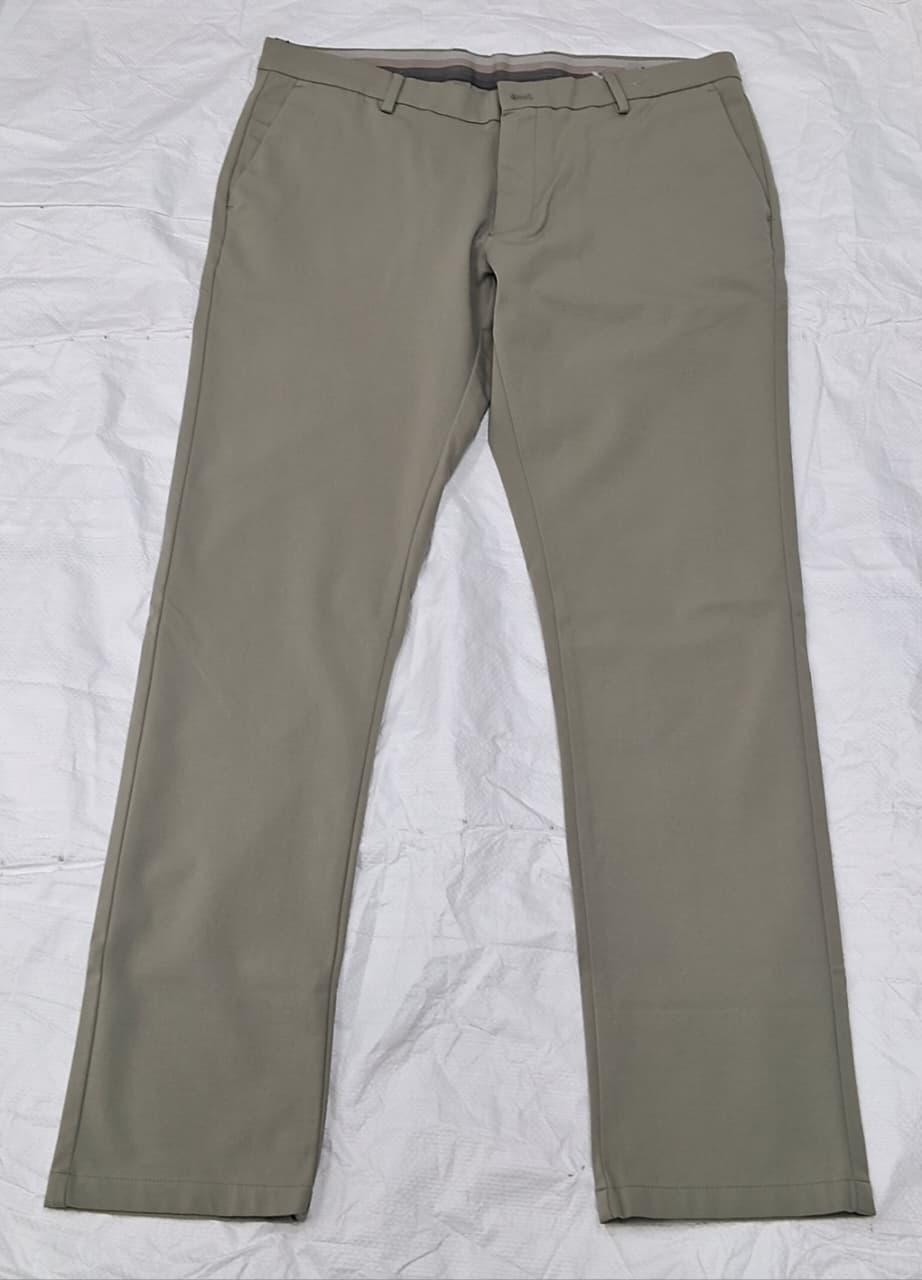
Sage green men's trousers laid flat
Plate J.01 — Sage green trousersFront view, laid flat

For most of the eighteenth century, a well-dressed European man did not wear trousers at all. He wore knee breeches with stockings, and long trousers belonged to labourers, sailors and working men. The formal trouser we now take for granted began as a borrowing from below — and from military dress — before it became the foundation of tailored clothing.

From breeches to trousers

Around the turn of the nineteenth century, fashionable men began to exchange breeches for longer, closer-fitting pantaloons and then for trousers proper. The change was gradual rather than sudden, and over the following decades trousers moved from daywear and riding into evening dress. By the middle of the century, full-length trousers had become the ordinary garment of the city, and breeches survived mainly in court and ceremonial costume.

Early trousers were often cut high, held up by braces rather than belts, and fastened with buttons. Some used a fall front — a buttoned flap across the front — before the centre fly became the norm. The idea that a trouser should sit at the natural waist, with shirt and waistcoat covering the join, persisted for a long time and still shapes classic formal trousers today.

The crease and the turn-up

Two details that now read as unmistakably formal arrived surprisingly late. The pressed front crease became common around the turn of the twentieth century, as pressing became part of the routine care of clothes. Before that, a sharp fold could simply suggest a garment that had been stored flat on a shelf. Once adopted, the crease gave the leg a clean vertical line, and it has defined formal trousers ever since.

The turn-up, or cuff, is associated with the Edwardian era. It began as a practical fold to keep hems clear of mud and became a style in its own right, adding a little weight at the ankle so the trouser hangs cleanly.

The details that define formal trousers today began as practical solutions — a fold against mud, a press against creasing — and stayed because they looked right.

Pleats, width and the post-war line

In the first half of the twentieth century trousers grew fuller. Front pleats released extra cloth over the hip so that a high-waisted, wide-legged trouser could move comfortably, and this generous silhouette dominated the years between the wars. After the Second World War the line gradually narrowed. Flat fronts, slimmer legs and a lower rise came to signal modernity, while belts and zip flies increasingly replaced braces and buttons.

Since then the pendulum has kept swinging: fuller, pleated trousers returned in some decades, very slim cuts dominated others. Each swing changed rise, leg width and length together, because those proportions are linked.

Where that leaves us

Today there is no single correct width. Men's formal trousers range from slim fit formal pants with a gentle taper to regular fit and straight cuts, and pleats are once again a respectable choice. What has stayed constant is the vocabulary — waistband, rise, crease, hem — and the idea that a formal trouser should look composed while letting the wearer move freely. The Lab explores that design thinking, and Construction looks at the details one by one.
Classic and contemporary trouser silhouettes

Two settings on the same set of dials — and how modern menswear learned to move between them.

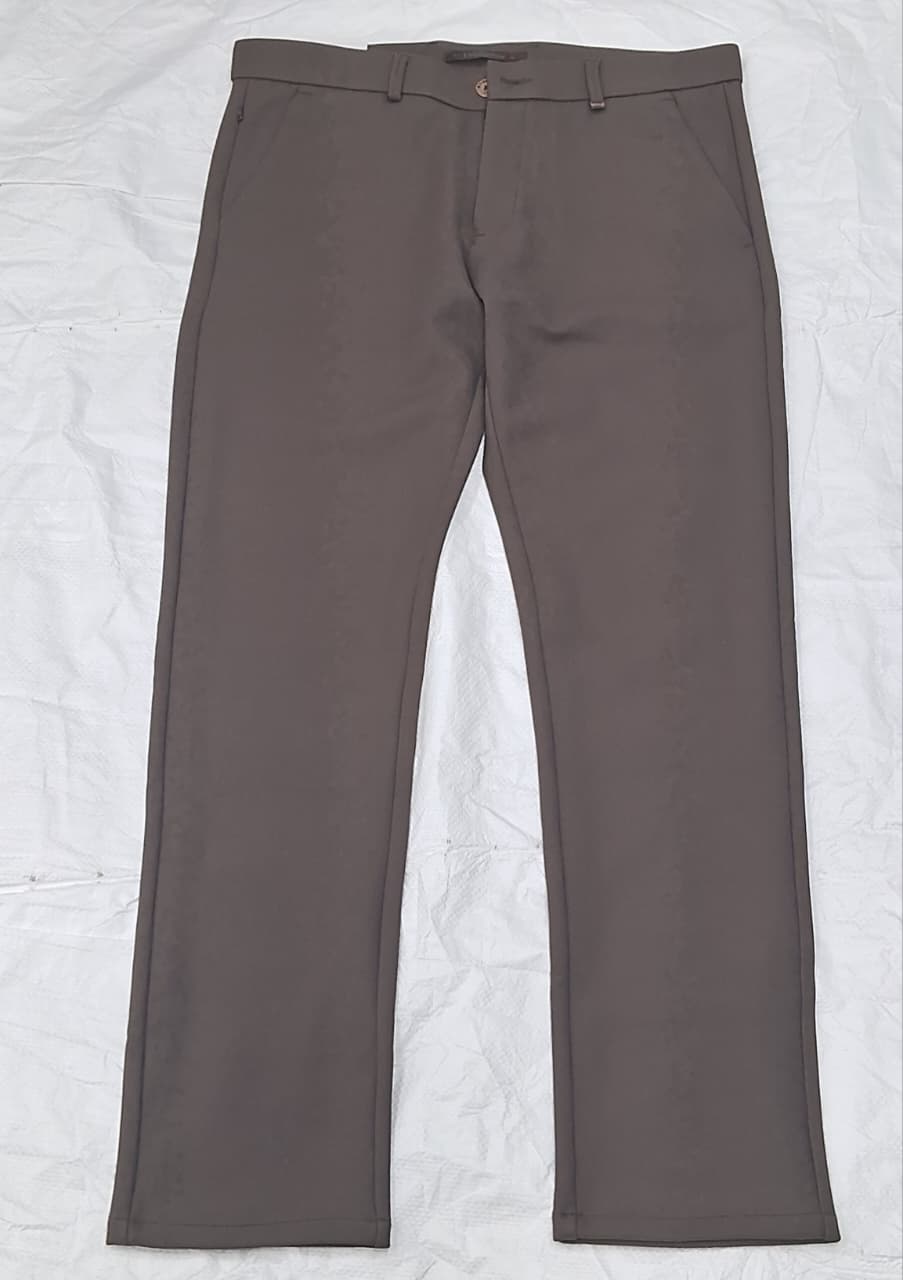
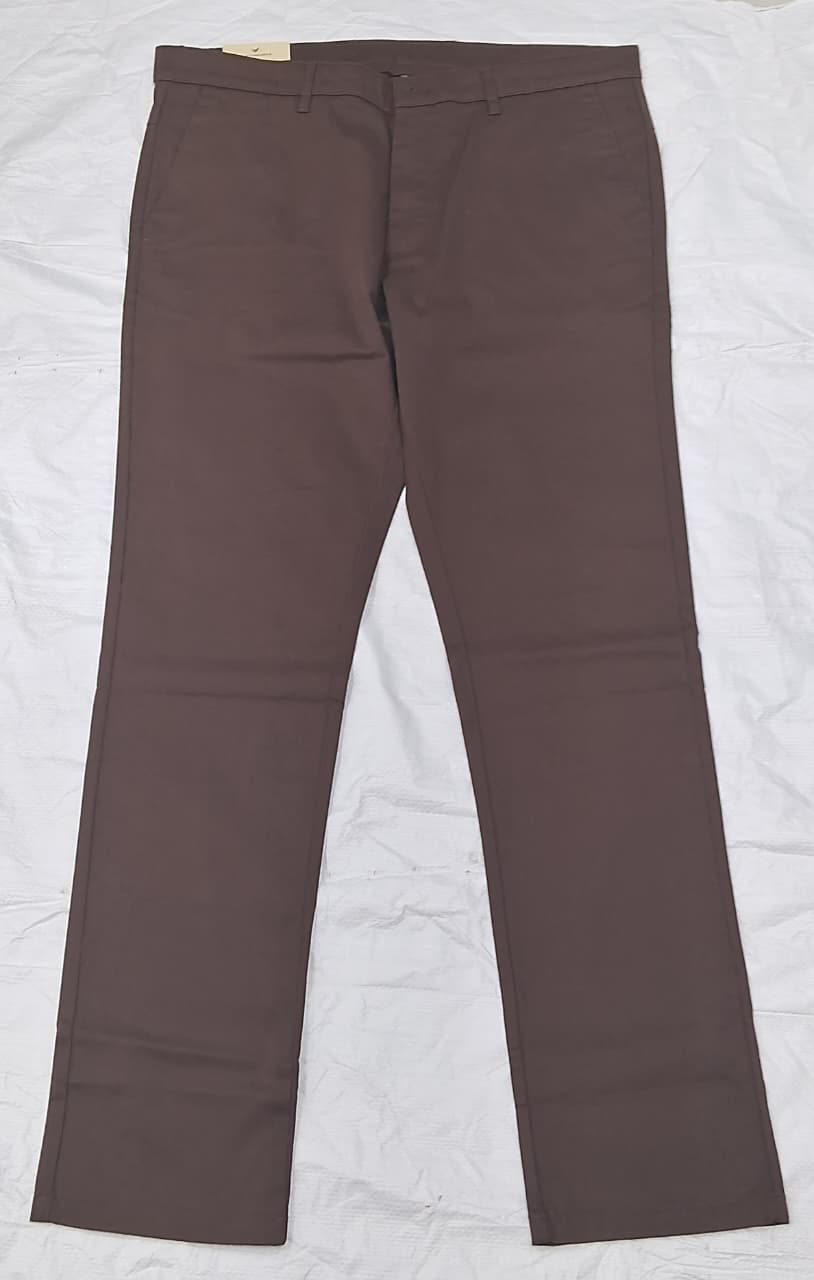
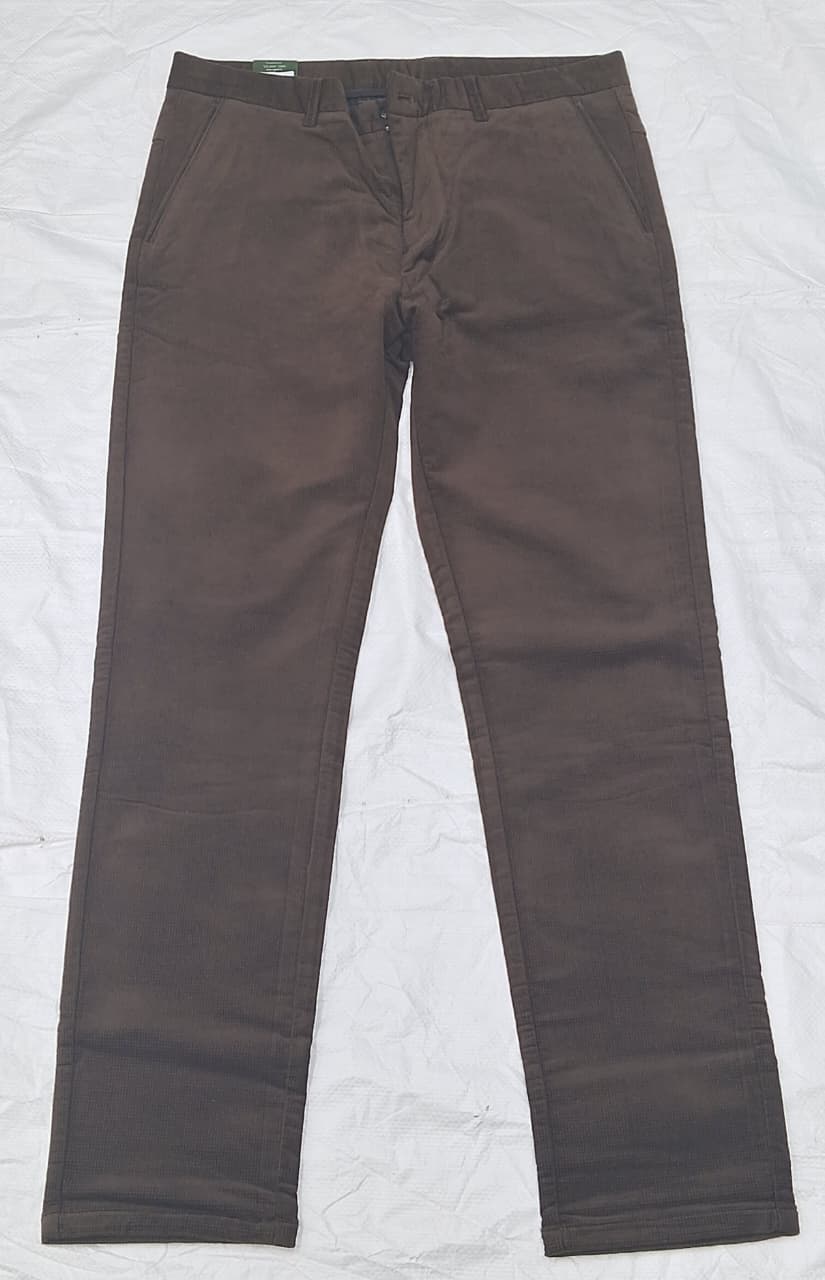
Mushroom brown men's trousers laid flat
Plate J.02 — Mushroom brown trousersFront view, laid flat

A silhouette is the outline a garment draws around the body. For trousers it is set by four dimensions working together — rise, seat, thigh and leg opening — and by the line that connects them. Read a trouser's silhouette and you can usually place it: classic or contemporary, formal or relaxed, deliberate or accidental.

The classic line

Classic formal trousers sit at or near the natural waist. The rise is generous, the seat is cut with room, and the leg falls in a straight or very gently tapered line to a hem wide enough to rest over the shoe. Pleats are common, the crease is sharp, and the overall effect is a long, unbroken column from waist to floor. This line was designed to sit beneath a jacket and waistcoat, which is why it looks so settled under tailoring.

The contemporary line

Contemporary trousers usually shorten the rise, trim the seat and thigh, and taper more noticeably below the knee. The hem narrows and the length shortens, so there is little or no break over the shoe. Flat fronts dominate. The result is lighter and more graphic: it shows the shape of the leg and pairs naturally with shorter jackets, fitted shirts and sleeker footwear.

Classic and contemporary are not opposites. They are two settings on the same set of dials.

How modern menswear moved between them

Over recent decades menswear has moved away from a single uniform towards a range of acceptable shapes. Tailoring became softer: jackets lost some of their padding, offices relaxed their dress codes, and trousers came to be worn as separates far more often than as half of a suit. A long period favouring very slim, low-rise trousers was followed by a return of higher rises, pleats and straighter or wider legs. Neither trend erased the other; both now sit side by side.

For the wearer this is good news. A slim fit formal pant and a pleated regular fit trouser can be equally correct. The real question is which suits your build, your jacket and your day.

Reading a silhouette in practice

  • Look at the side profile. A straight back line from seat to heel looks classic; a line that follows the calf looks contemporary.
  • Check the hem against the shoe. A wider opening covers more of the shoe and suits a slightly longer length; a narrow opening reads best a little shorter.
  • Match the jacket. Longer, structured jackets balance fuller trousers; short, soft jackets suit slimmer lines.
  • Consider the occasion. The more formal the setting, the more the classic line tends to win.

The Trouser Collection catalogues each of the formal trouser styles, and Style Systems shows how they combine with shirts, jackets and shoes.

The importance of fit and proportion

Why fit matters more than any other choice, and how to read a trouser's balance in a mirror.

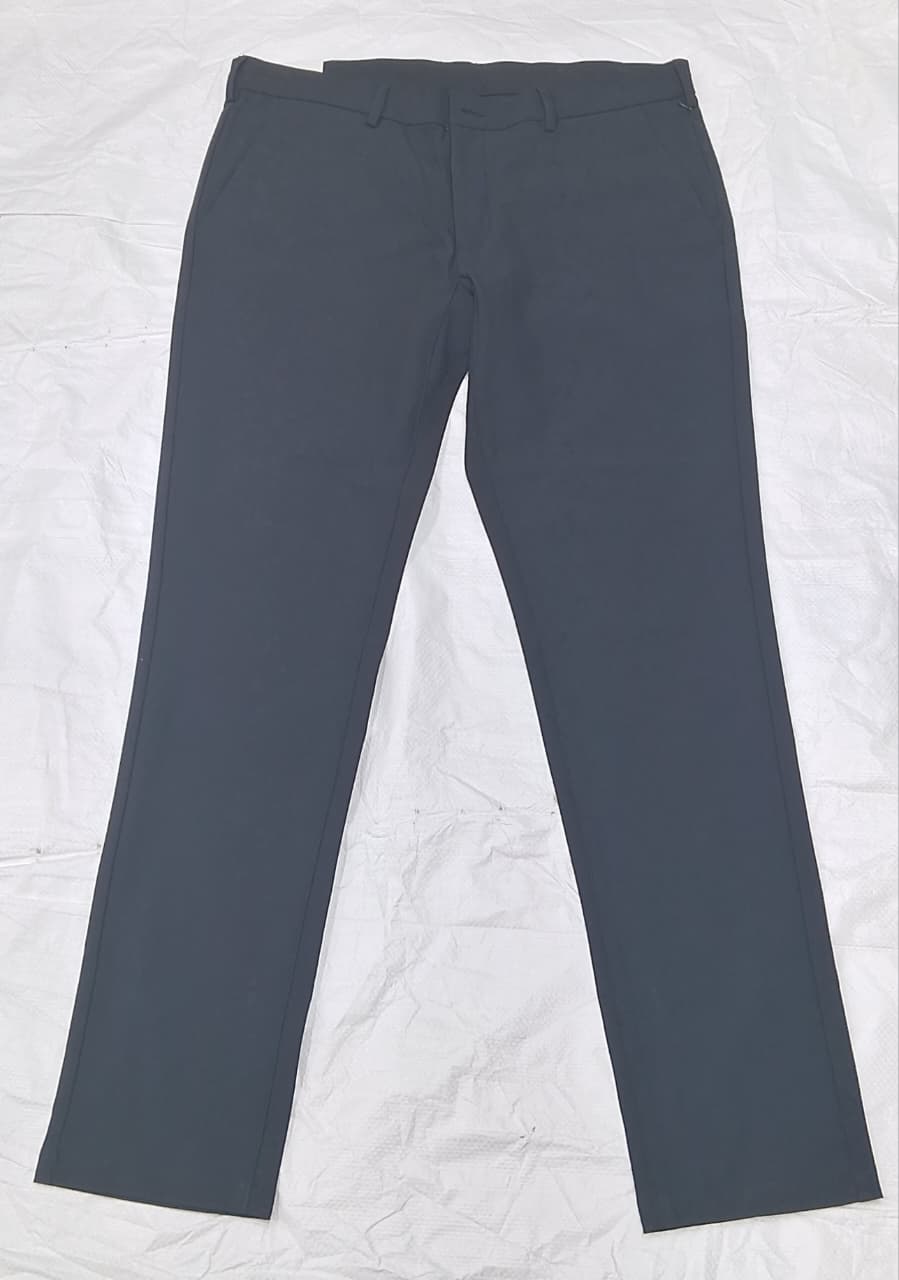
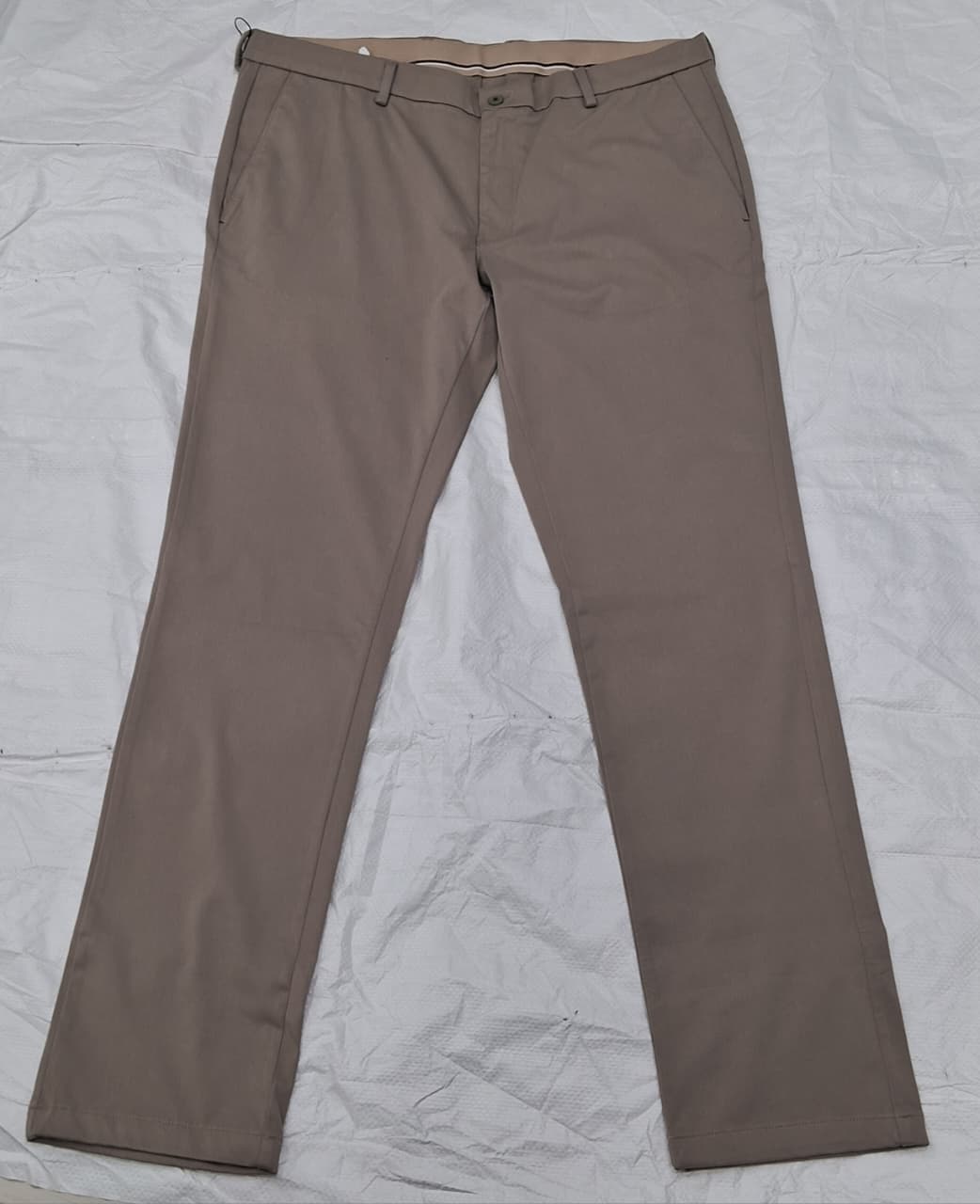
Dark taupe men's trousers laid flat
Plate J.03 — Dark taupe trousersFront view, laid flat

Fit is the single largest factor in how a pair of men's formal trousers looks. Two trousers in the same colour and cloth can look completely different — one precise, one careless — purely because of how they sit on the body. Proportion is the larger idea behind fit: how the trouser relates to the person wearing it and to the rest of the outfit.

Fit is a set of relationships

It is tempting to think of fit as a waist size and a leg length. In practice a trouser fits when a chain of dimensions agree with each other and with the body: the waist closes comfortably, the rise places the waistband where it belongs, the seat follows the hip without pulling, the thigh has room to sit, and the leg narrows evenly to an opening that suits the shoe. When one link is wrong the whole line suffers. A tight seat creates horizontal strain lines; a short rise drags the waistband down when seated; an over-long leg piles cloth at the ankle and breaks the crease.

A well-fitted trouser is quiet. You notice the person, not the cloth.

Proportion and the vertical line

Trousers cover the whole lower half of a standing figure, so they have a strong effect on how tall and how balanced someone appears. A higher rise and an unbroken crease extend the line of the leg. A strong contrast between a dark trouser and a light shirt divides the figure at the waist; a closer tonal match lengthens it. Leg width should relate to build: very narrow trousers can make a broad frame look top-heavy, while very full trousers can overwhelm a slight one.

The jacket matters too. The hem of a jacket and the rise of a trouser together decide where the body appears to divide. If the trouser sits low and the jacket is short, a strip of shirt shows between them and the proportion falls apart.

A mirror test

  • Stand. The crease should fall straight down the centre of the leg and land on the shoe.
  • Turn sideways. Look for a smooth seat — no folds hanging below it, no strain across it.
  • Sit. The waistband should not dig in or gape at the back, and the thigh should not grip.
  • Walk. The hem should move with you and settle back without riding up the shin.

None of this needs a tape measure. It needs a few minutes in front of a mirror, in the shoes you will actually wear. Fit Engineering works through the nine fit dimensions one at a time — it is the full men's trouser fit guide — and the Trouser Collection shows how slim, regular and straight cuts express them differently.

Understanding trouser construction and garment details

Waistbands, fronts, pockets, seams and hems — the vocabulary for judging a formal trouser by eye and by hand.

Taupe men's trousers laid flat
Plate J.04 — Taupe trousersFront view, laid flat

Construction is the part of a trouser most people never look at, yet it decides how long the garment keeps its shape and how comfortable it is after a full day. Learning a handful of terms makes it much easier to judge men's formal trousers by eye and by hand.

The waistband

The waistband is the structural top edge of the garment. In formal trousers it is usually stiffened with interfacing so it does not roll or collapse, and it may be faced on the inside with a strip of cloth often called a curtain. Closures vary: a simple button, a flat hook-and-bar that spreads tension across the front, or a combination of the two with an inner button. Belt loops hold a belt level; side adjusters, where used, replace the belt altogether for a cleaner line.

The front

Below the waistband, the front is either flat or pleated. Pleats are folds stitched at the top and released below, giving room over the hips; a flat front relies on careful shaping and less cloth instead. The fly closes with a zip in most modern trousers, though button flies survive in some traditional tailoring.

Pockets

Side pockets may be slanted — angled from the waistband towards the side seam — or set straight into the side seam itself, where they almost disappear. Back pockets on formal trousers are usually jetted: a slit finished with narrow, flat strips of cloth, sometimes closed with a button or covered by a flap. Good pockets are bagged in a smooth, strong lining and lie flat when empty.

The best construction is invisible from the outside. It shows up as a trouser that still looks pressed at the end of the day.

Seams, crease and hem

Every trouser is built from a few long seams: the outseam down the side, the inseam along the inner leg and the seat seam joining the back. In tailored trousers the seat seam is sometimes cut with extra allowance so the waist can be adjusted later. The front crease is pressed along the grain of the cloth; on some fabrics it is set with a finishing process so that it lasts longer between pressings.

The hem finishes the leg. A plain hem is the most formal; a turn-up adds weight and a traditional accent. Inside, some trousers carry a strip of tape at the back of the hem to protect it from wear against the heel of the shoe.

Why it matters

These details are not decoration. They distribute stress, control drape and determine how the garment ages. When two pairs of formal trousers look alike on a hanger, the one with the firmer waistband, flatter pockets and cleaner seams will usually look better on the body. Construction takes each element in turn, and the Material Library explains how cloth affects all of them.

Formal dressing in modern workplaces

Dress codes have loosened and diversified. The formal trouser is the piece that moves across all of them.

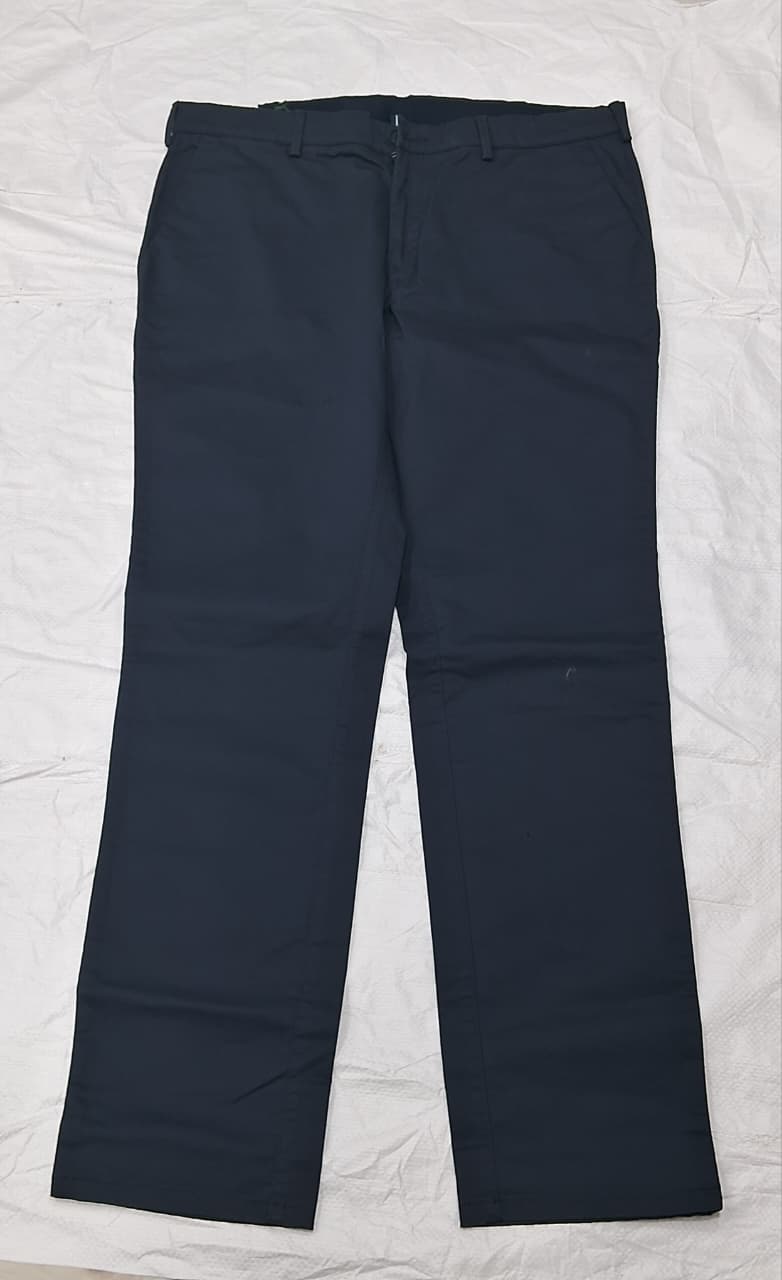
Navy men's trousers laid flat
Plate J.05 — Navy trousersFront view, laid flat

Workplace dress codes have become more varied. Some offices still expect suits every day; many have moved to business formal or business casual; others leave it largely to judgement. Through all of these changes one garment has stayed remarkably constant: the formal trouser. It moves more easily between levels of formality than any other piece, which makes it the backbone of modern professional dressing.

A spectrum, not a rule

It helps to think of office wear for men as a spectrum. At the formal end sits the matching suit with a tie. One step down is the odd jacket — a blazer or sports coat — worn with contrasting formal trousers and a collared shirt. Next comes business casual: formal trousers with a shirt and perhaps knitwear, no jacket. At the relaxed end, smart casual allows chinos or textured trousers with polos or open collars. Formal pants for office wear appear at almost every step, and even at the relaxed end a well-cut pair lifts the whole outfit.

What the working day asks of trousers

Office trousers are worn for long hours — sitting, commuting, standing in meetings. That makes comfort and recovery as important as appearance. Cloth that resists creasing at the knee and seat, a waistband that stays comfortable when seated, and a rise that keeps the shirt tucked all matter more than any trend. In warm, humid cities such as Mumbai, lighter, breathable fabrics and slightly easier fits tend to stay comfortable through the day.

The modern office rewards trousers that look composed in the morning and still look composed in the evening.

Separates over suits

Many professionals now build a working wardrobe around separates rather than suits. A few pairs of men's office trousers in dependable colours, rotated with different shirts and jackets, produce more combinations than the same number of suits — and each piece can be replaced on its own schedule. This is one reason navy, charcoal and mid grey trousers sit at the heart of so many office wardrobes.

Practical guidance

  • Dress for the most formal part of the day. It is easier to remove a jacket than to wish you had brought one.
  • Keep the crease. A pressed crease is the quickest signal of a formal trouser; restore it regularly.
  • Mind the shoes. Leather Oxfords and Derbies suit formal trousers; loafers work in more relaxed settings.
  • Rotate. Giving trousers a day of rest between wears helps the cloth recover its shape.

Style Systems sets out complete outfits for corporate days, business casual and travel, and Colour Studies looks at which shades carry each setting.

Choosing colours for professional wardrobes

Dependable darks first, earth tones second — and the contrast, value and undertone rules that make them combine.

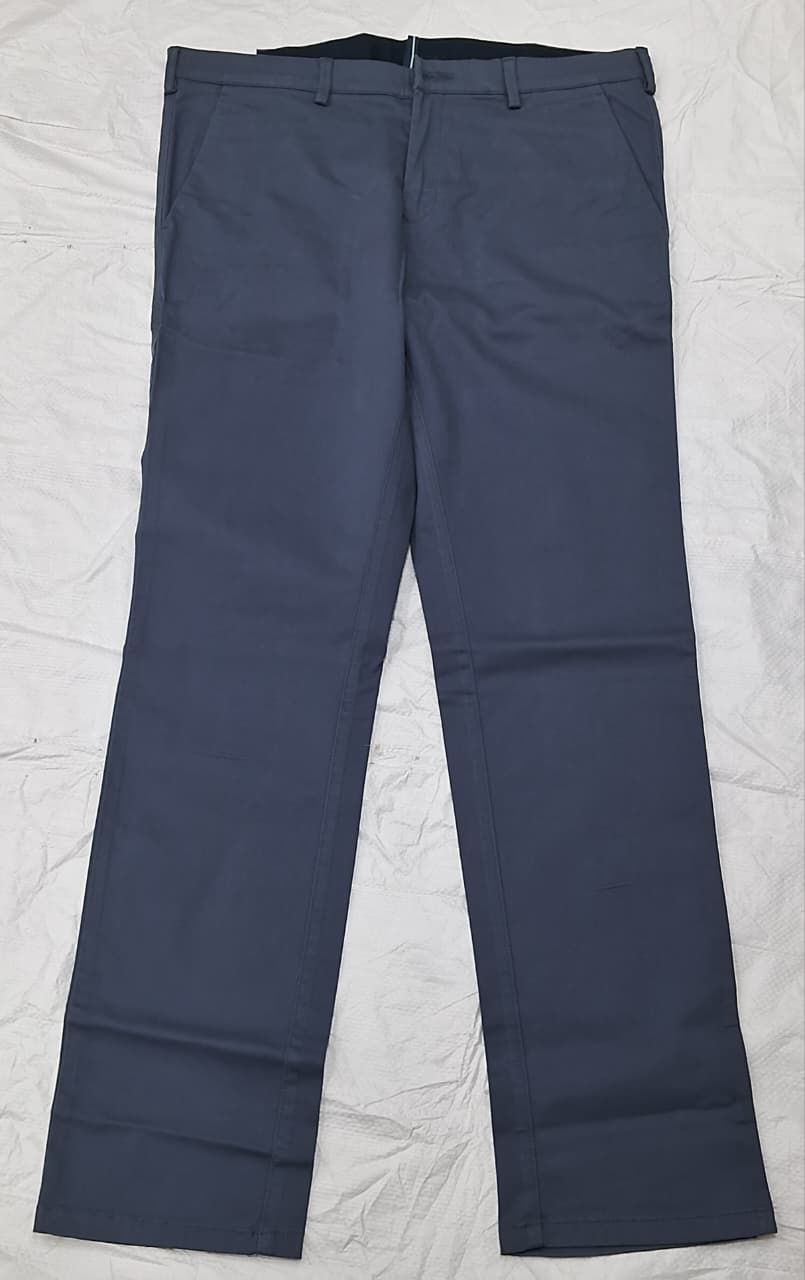
Slate grey-blue men's trousers laid flat
Plate J.06 — Slate grey-blue trousersFront view, laid flat

Colour does more work in a professional wardrobe than almost any other choice. It signals formality, controls how easily pieces combine, and determines how often a trouser can be worn without being noticed. A disciplined palette is the reason some men seem to have endless outfits from a modest wardrobe.

Start with the dependable darks

Navy and charcoal are the usual foundation for formal trousers for men. Both are dark enough to look formal, neutral enough to pair with white, light blue and pale pink shirts, and different enough from each other to give two distinct looks. Mid grey is the natural third: slightly lighter, a little softer, and easy to wear with a navy jacket.

Black is the most formal colour and has its place at evening events and in very formal settings. In daytime office wear it can look severe, and it is harder to pair with brown shoes or with jackets that are not also black — which is why many wardrobes treat it as a specialist piece rather than a staple.

Then the earth tones

Browns, taupes, beiges and olives bring warmth. They read slightly less formal than greys and blues, and they come into their own in business casual settings, with knitwear and in warmer weather. Trousers in these shades pair well with navy blazers, white and blue shirts, and brown leather shoes.

Choose colours that agree with each other, and every new piece multiplies the outfits you already own.

Contrast, value and undertone

  • Value contrast. A dark trouser with a light shirt gives a crisp, formal split. Keeping trouser and jacket close in depth produces a calmer, longer line.
  • Avoid near-misses. A navy trouser with a slightly different navy jacket can look like a mismatched suit; a clearer contrast — grey with navy, for example — looks intentional.
  • Undertones. Warm greys and taupes lean towards brown; cool greys and slate lean towards blue. Grouping warm with warm and cool with cool makes combinations feel coherent.
  • Light. Office lighting and daylight change colours. Check dark shades in natural light, where navy and black are easiest to tell apart.

A sensible order

For a first professional wardrobe, many people begin with navy and charcoal, add mid grey, and then introduce one earth tone such as brown or beige for variety. Each step should combine with what is already there. Colour Studies examines each shade in detail, and Style Systems shows them at work in complete outfits.

The relationship between fabric and appearance

Fibre, weave, weight and finish — how cloth decides drape, sheen and the life of a crease.

Blue men's trousers laid flat
Plate J.07 — Blue trousersFront view, laid flat

Two trousers with the same pattern and the same fit can look entirely different because of the cloth they are made from. Fabric decides how a trouser drapes, whether it holds a crease, how it reflects light and how it behaves after hours of wear. Understanding formal trouser fabric in general terms makes it easier to choose the right pair for the right setting.

Fibre: the raw character

Wool is the traditional cloth of tailoring. It drapes well, recovers from creasing and holds a pressed line. Cotton is matte and comfortable but creases more readily and holds a crease less sharply, which is why cotton trousers often read a little more casual. Linen is cool and breathable, with a natural crumpled texture that suits hot weather and relaxed settings. Synthetic fibres such as polyester, and regenerated fibres such as viscose, are often blended with natural ones to add durability, crease resistance or smoothness, while a small proportion of elastane adds stretch.

Weave and weight

How the yarns are woven matters as much as what they are. Plain weaves are simple and crisp. Twills, recognisable by their fine diagonal lines, are typically more supple and drape more fluidly; gabardine is a tightly woven twill known for its smooth, hard-wearing surface. Heavier cloths hang with more authority and resist wrinkling; lighter cloths are cooler but show creases sooner. Choosing a weight is therefore a decision about climate as much as appearance.

Fit gives a trouser its shape. Fabric decides whether it keeps it.

Surface and finish

Surface texture changes formality. A smooth, fine cloth with a soft lustre looks most formal; a matte, textured or melange surface looks more relaxed and disguises creasing better. Strong shine tends to look less refined, particularly in daylight. Finishing processes can also change how a cloth feels and how long a pressed crease lasts.

Matching fabric to the day

  • Long office days: cloths with good crease recovery keep the trouser looking pressed.
  • Heat and humidity: lighter, breathable fabrics and more open weaves stay comfortable.
  • Travel: blends with some synthetic content or stretch tend to resist wrinkling and pack well.
  • Formal occasions: smooth, fine cloths with a quiet surface look the most considered.

The Material Library looks at each fibre and blend in turn, and Construction explains how cloth interacts with seams, crease and hem.

Note

This entry is general information about formal trouser fabric. It does not describe the fabric content of the trousers photographed on this page, or of any garment at Options Mall.

Building a versatile formal wardrobe

A small set of trousers chosen so that almost everything combines — and how to style formal trousers once you have them.

Mauve brown men's trousers laid flat
Plate J.08 — Mauve brown trousersFront view, laid flat

A versatile formal wardrobe is not a large one. It is a small set of pieces chosen so that almost everything combines with everything else. Men's formal trousers are the best place to start, because they are worn most often and anchor every outfit built above them.

Begin with a core

Three to five pairs of formal trousers cover most working weeks. A practical core might be navy, charcoal and mid grey in a fit that suits you, followed by one earth tone — brown, taupe or beige — for warmth and variety. Keep the fit consistent at first, so every pair works with the same shoes and jackets; introduce a second silhouette, such as a pleated or straight cut, once the basics are in place.

Plan the layers above

Shirts can stay within a narrow range of light colours — white, light blue, pale stripes — that sit comfortably with every trouser in the core. One navy blazer and one grey or textured jacket can then be paired with nearly every trouser. Fine knitwear adds a softer option for business casual days.

Versatility comes from agreement: colours that combine, fits that share shoes, pieces that each work in more than one setting.

Styling formal trousers

  • Tuck and belt. A neatly tucked shirt and a belt that matches the shoes give formal trousers a clean waistline.
  • Shoes set the register. Black Oxfords for the most formal days; brown Derbies or loafers for everyday and business casual.
  • Socks bridge the gap. Socks close in colour to the trouser extend the leg line when you sit.
  • Length to suit the shoe. A slight break works with most formal shoes; slimmer trousers suit little or no break.
  • Texture adds interest. When colours are quiet, a textured trouser or a knit adds depth without noise.

Care keeps it versatile

A wardrobe stays useful only while it stays presentable. Hang trousers by the hem or fold them along the crease, give each pair rest between wears, follow the care label, and refresh the crease when it softens. Small, regular care keeps trousers looking good for longer than occasional heavy cleaning.

Growing it deliberately

When adding a new pair, ask how many existing pieces it works with. A trouser that pairs with every shirt and both jackets earns its place; one that needs its own outfit rarely does. Style Systems shows complete combinations, Colour Studies explains the palette, and the Trouser Collection catalogues the forms.

§ IndexSubject index

Read by subject.

The same ideas recur across the journal — fit shapes styling, fabric shapes construction, colour shapes the whole wardrobe. This index cross-references every tag with the entries that discuss it, so you can follow one thread through the notebook.

For reference material rather than essays, the numbered sheets go deeper: Fit Engineering for the men's trouser fit guide, Material Library for fabric, and Colour Studies for the palette.

09About OptionsNext sheet →